Stormwater and Land Disturbance
Jurisdictional Area
NC State University has been issued a National Pollutant Discharge Elimination System (NPDES) Municipal Separate Storm Sewer System (MS4) Permit (NCS000376) by the North Carolina Department of Environmental Quality (NCDEQ) on behalf of the Environmental Protection Agency (EPA). Under this permit, responsibility is delegated to NC State University’s Environmental Health and Safety for review and approval of development plans for meeting Federal, State, and local stormwater management requirements.
The jurisdictional areas of this permit include North Campus, Central Campus, West Campus, South Campus, Centennial Campus, Centennial Biomedical Campus, and the Carter-Finley Stadium complex.
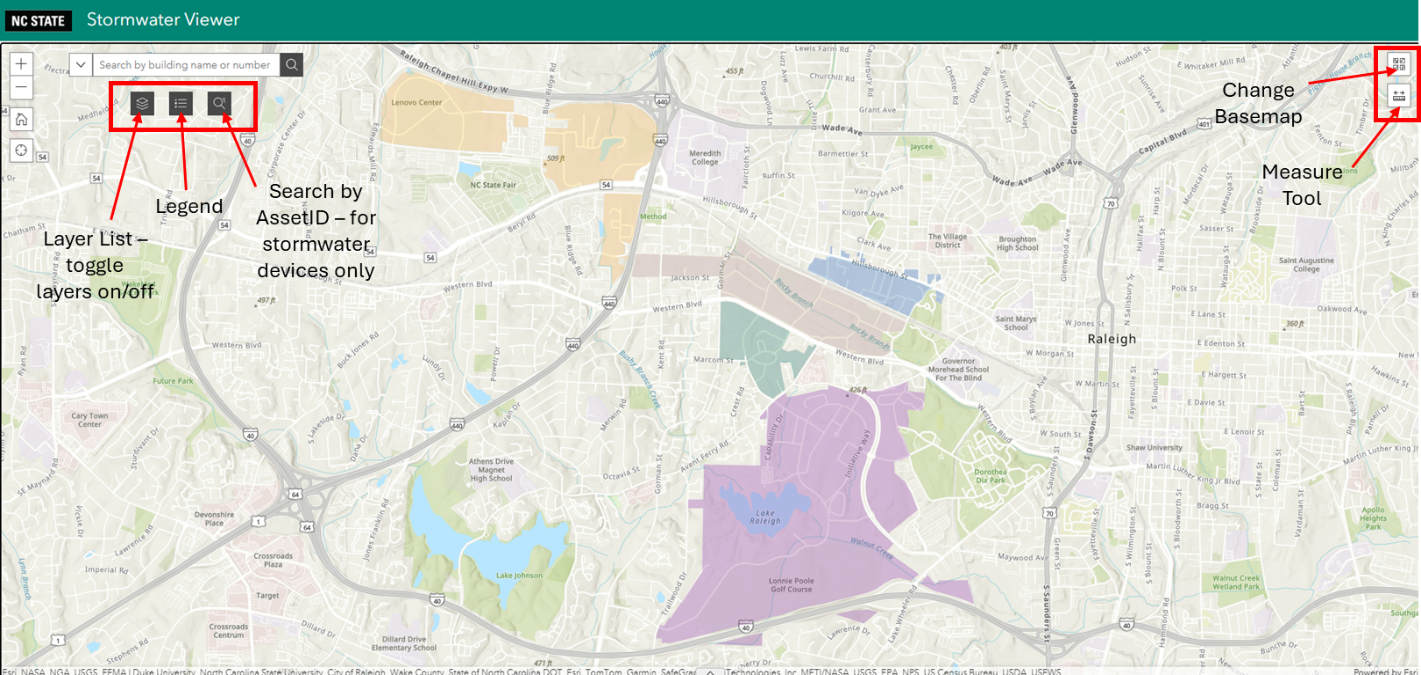
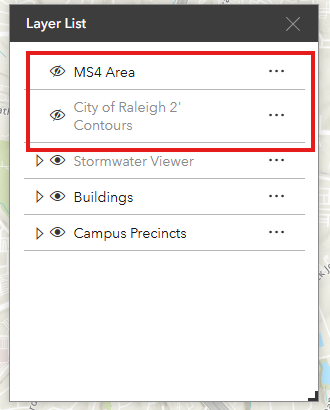
See NC State University’s published Stormwater GIS for the jurisdictional boundaries of our stormwater permit: Stormwater Viewer here. Note that the “MS4 area” must be selected in the Layer List by clicking on the eye to enable them:
Design Standards and Forms
Stormwater Management Design Standards
Forms:
- Stormwater Management Plan Submittal for Minor Land Disturbance Projects
- Annual Certification of Stormwater Inspections and Maintenance
- Stormwater Acceptance and Transfer of Maintenance Responsibility
Checklists:
- Stormwater Management Design Report Submittal Checklist
- Erosion and Sediment Control Submittal Checklist
- Record Drawing Submittal Package Checklist
- Stormwater Management Plan Submittal Checklist
Overview of NC State Stormwater Design Standards:
Stormwater Management Plan (SWMP) Permitting Process
- Consultation with EHS Stormwater is highly recommended as early as possible and throughout all phases (Planning through Record Drawings). A Schematic Design Meeting is required.
- EHS Stormwater reviews and approves all plans with any increase in built upon area (BUA) and all plans with land disturbance greater than 0.1 acre.
- EHS Stormwater reviews include requirements for (1) Stormwater Control, (2) Neuse Nutrient Strategy, (3) Neuse Buffer Rule, and (4) Erosion and Sediment Control.
- EHS Stormwater will issue an approval letter once all requirements are met; land disturbance cannot begin without this Stormwater Management Plan (SWMP) Approval and Approval Number.
- If the land disturbance is greater than 1 ac, a Land Disturbance Permit (NCG01) from DEQ is also required before the construction can begin. DEQ only reviews the erosion and sediment control component of the Stormwater Management Plan (SWMP), EHS reviews all 4 components.
- The City of Raleigh no longer has any involvement in the stormwater management or erosion and sediment control permitting, inspecting, or approval process.
- A pre-construction meeting is required.
Nutrient Management
- Nitrogen Buydown
- Nutrients can only be bought down after a primary Stormwater Control Measure (SCM) treats 100% of the new/proposed BUA
- Nitrogen Loading Rates
- Bioretention, infiltration, and permeable pavers are the preferred SCM. With 100% sizing, nitrogen loading target rates are assumed to be met. SNAPTool analysis is not required for these devices. The new SNAPTool is required for all other SCMs. (Please note that underground detention SCMs are not a permissible SCM.)
- Runoff Volume Match
- A project may be exempt from nutrient treatment with a report showing no more than 2% increase to the annual runoff volume of the proposed condition relative to the existing condition.
- Treatment location
- Treatment should be as close to site LOD as possible but is permitted within the precinct boundary as long as peak flow increases do not impact adjacent areas.
- SCM Retrofits
- “Unregulated” SCMs can be modified and certified to meet MDC criteria and volume can be credited to small projects
- Dry Detention SCMs can be retrofit to a Modified Bioretention
NC State Peak Flow Requirements
- Peak Flows
- 1-, 2-, and 10-year storms managed to existing conditions. No more than a 2% increase is permitted.
Stormwater Control Design Requirements
- General
- Add the SCM Design block to the plan with SCM type, WQv and Total volume provided, and Regulatory Requirements check to the first sheet of the SCM Design Plan.
- Add grid ticks (3) with northing/easting for georeferencing the SCM plan.
- No underground facilities permitted.
- NC Pond Code 378
- Embankments 3ft or greater are dams.
- Filter diaphragm required for all penetrations through the embankment.
- Geotech min 2 soil borings (soils, bearing strength).
- Clay core/materials requirement (Unified Soil Classification MH, ML, SC, SM, CH, or CL material)
- Dam construction compaction (8″ lifts, 95% compaction)
- Freeboard (1 ft or 2 ft, see Code 378)
- Flood inundation map is required.
- “No woody veg zone” (15-ft buffer around embankment and control structures)
- Proposed dam height = settled dam height + 10%
- Structural/Geotech requirements
- Soils material and bearing strength (geotechnical certification during design phase)
- Anti-floatation comps for risers or any hollow structural control (possible structural or geotechnical calculation during design phase)
- Riser construction in single pour or cast in place with rebar and key (geotechnical and structural certifications during construction phase)
- Dam compaction (geotechnical certification during construction phase)
- SCM O&M Plan
- O&M added directly to design plans and Record Drawing package
- Call-out clean out elevation
- Note the expected design drawdown time
- Delineate a “no woody veg zone” around embankment and control devices in plan view
- Storm Drains
- All existing storm drain pipes and structures within the limits of disturbance of a project must be replaced or removed unless “good condition” of the storm drain pipes/structures to remain can be demonstrated
- All existing storm drains within the limits of disturbance of a project that connect steam tunnels, mechanical rooms, or other illicit discharge sources must be redirected to the sanitary system.
- 10-year hydraulic grade line (HGL) shown on pipe profiles to ensure no inlet surcharge
- Storm drain pipes coming into an SCM must be level and water tight
- Storm drain pipes must enter an SCM below permanent pond (wet pond) or level with media (dry SCM)
- Storm drain pipes to an SCM or on steep slopes must end with headwalls, no flared end sections
- Emergency Spillway
- Profile and Cross Section are required
Erosion and Sediment Control Submittal
- Add the Stormwater Management Plan block with LOD Area, EX BUA, PR BUA, and Neuse Buffer Zone check to the first sheet of the E&SC Plan
- Fabric/Filtration-type erosion and sediment controls must be used to minimize suspended sediment to downslope SCMs or streams
- Silt Fence must align with the contour to maintain filtration approach by eliminating stone outlets, where possible
- Call-out 10-year velocities on outfalls and conveyance slopes, must be returned to 3 fps at return to existing
- Note the DEQ 50 NTU turbidity requirement on plans
Record Drawing Submittal
- The Record Drawing package must be submitted within 30 days of the functional completion of SCM, as determined by the Design Engineer.