Stormwater and Land Disturbance
- Jurisdictional Area
- Design Standards and Forms
- Approval Process
- Inspections and Maintenance
NC State University has been issued a National Pollutant Discharge Elimination System (NPDES) Municipal Separate Storm Sewer System (MS4) Permit (NCS000376) by the North Carolina Department of Environmental Quality (NCDEQ) on behalf of the Environmental Protection Agency (EPA). Under this permit, responsibility is delegated to NC State University’s Environmental Health and Safety for review and approval of development plans for meeting Federal, State, and local stormwater management requirements.
The jurisdictional areas of this permit include North Campus, Central Campus, West Campus, South Campus, Centennial Campus, Centennial Biomedical Campus, and the Carter-Finley Stadium complex.
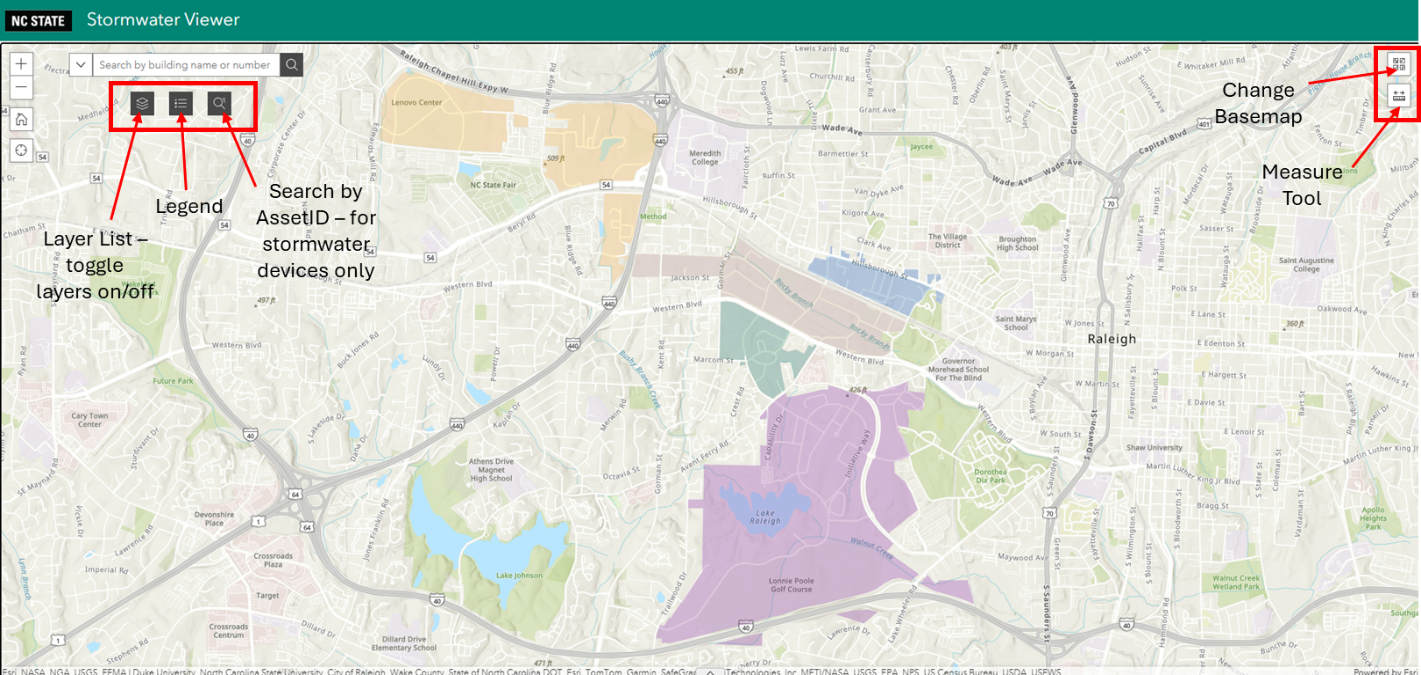
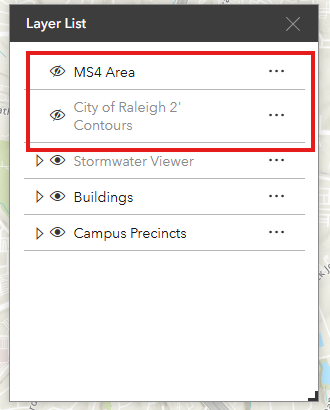
See NC State University’s published Stormwater GIS for the jurisdictional boundaries of our stormwater permit: Stormwater Viewer- https://go.ncsu.edu/ncstate-stormwater-viewer. Note that the “MS4 area” must be selected in the Layer List by clicking on the eye to enable them:
Stormwater Management Design Standards
Forms:
- Stormwater Management Plan Submittal for Minor Land Disturbance Projects
- Annual Certification of Stormwater Inspections and Maintenance
- Stormwater Acceptance and Transfer of Maintenance Responsibility
Checklists:
- Stormwater Management Design Report Submittal Checklist
- Erosion and Sediment Control Submittal Checklist
- Record Drawing Submittal Package Checklist
- Stormwater Management Plan Submittal Checklist
Overview of NC State Stormwater Design Standards:
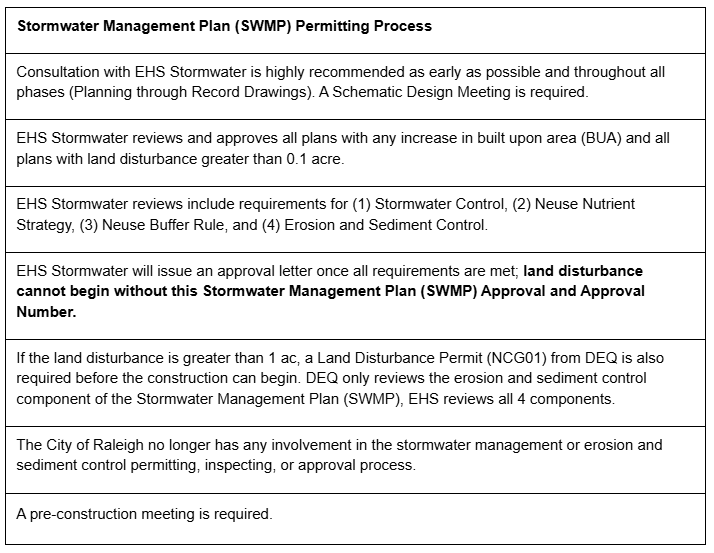


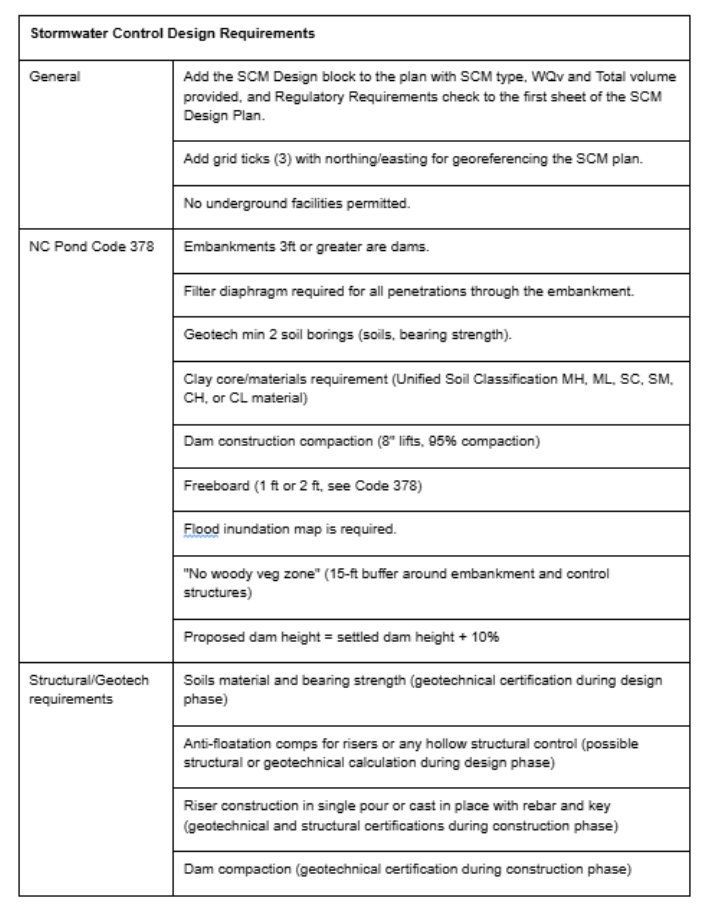
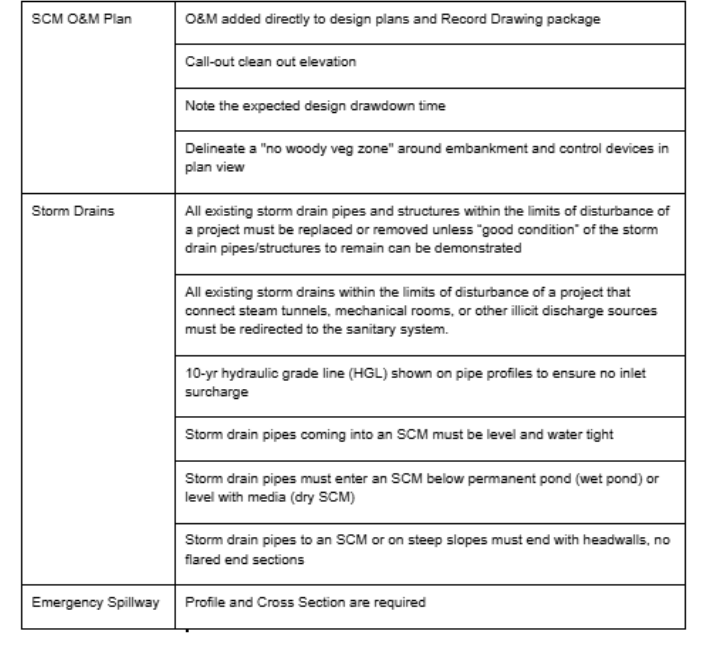


All projects with any increase in build upon area (BUA) and all plans with a land disturbance of 0.1 acre or greater require a Stormwater Management Plan (SWMP), approved by NC State. The four parts of a SWMP include:
(1) Stormwater Controls,
(2) Nutrient Management,
(3) Neuse Buffer Rule, and
(4) Erosion and Sediment Controls.
Before the final SWMP approval letter can be issued, a General Permit (NCG01) from the Department of Environmental Quality (DEQ) is also required for any land disturbance activities resulting in an area greater than or equal to 1 acre. No land disturbance can begin without the issuance of a SWMP approval letter from Environmental Health and Safety (EHS).
Although all four parts of the SWMP may not apply to every project, each component must be addressed by demonstrating compliance with State and local criteria or providing justification for non-applicability. The Stormwater Management Plan (SWMP) block, shown below, must be added to the erosion and sediment control plan. In some cases, the SWMP block showing that the proposed built upon area (PR-BUA) is less than or equal to the existing built upon area (EX-BUA) may be satisfactory justification to address the Stormwater Controls and Nutrient Management components. Similarly, if the project is outside of the Neuse buffers, justification for the Neuse Buffer Rule can be addressed by the SWMP block. Neuse Buffer Zones 1 and/or 2, if within 100’ of the limit of disturbance (LOD) must also be delineated on the plans. For more complex situations, a stormwater management report with rationale and data justification will be required.
Early and ongoing consultation with EHS Stormwater is strongly recommended to ensure alignment throughout all project phases. Comment responses must be included with each design submission. For projects following the NC State Formal or Informal Design processes, the EHS Stormwater requirements for the Design Development Project Phase must be approved prior to moving forward to the Contract Documents Project Phase.
Note: The EHS Stormwater review process may take up to 30 days.
Once all components of the SWMP have been satisfactorily addressed, EHS will issue a SWMP approval letter and SWMP number. All approved plans and permit approval letters are required to be kept on site at all times during construction. Any changes to the SWMP must be resubmitted to EHS Stormwater for approval.
Submittal Deliverables
Comment responses and completed checklists are required with each submittal. Checklists can be found in Appendix A. Unless otherwise specified below, one paper copy and one pdf copy of each deliverable must be submitted to EHS Stormwater.
Schematic Design Phase
Project Summary
Project Location
>SCM type(s) and location(s)
Schematic Design Meeting (to be scheduled within 4 weeks of receipt of deliverables above)
Design Development Phase
Stormwater Management Design Report
Stormwater Management Plans
Erosion and Sediment Control Plans
Shapefiles to be submitted: (1) drainage area(s), (2) dam breach inundation area
Contract Document Phase
Stormwater Management Design Report, if any changes have been made
Stormwater Management Plans
Erosion and Sediment Control Plans
Full project plans - all disciplines (paper copy of all-discipline plans not required, pdf only is acceptable)
Stormwater Maintenance Agreement
Nutrient Offset Fees, if applicable
For projects with an LOD of 1 acre or greater:
NCDEQ Letter of Plan Approval
NCDEQ Certificate of Coverage
Financial Responsibility/Ownership Form
Record Drawing Submittal
Stamped and signed Record Drawings, certifying that the as-built conditions meet the design standards and satisfy the intent of the stormwater management design
Revised volume calculations for all SCMs
Stormwater Acceptance and Transfer of Maintenance Responsibility Form (see Appendix B), signed by the Engineer
Construction Phase
EHS Stormwater must be notified at least 2 weeks prior to the intended commencement of any land disturbance so that a preconstruction meeting can be scheduled. If the project also requires NCDEQ Sediment and Erosion Control Inspections, the contractor must also contact the NCDEQ Inspector to attend the preconstruction meeting.
Erosion and sediment controls must be in place and approved by the NC State Erosion and Sediment Control Inspector prior to beginning work. All approved plans and permit approval letters are required to be kept on site at all times during construction. Any changes to the plan must be resubmitted to EHS for approval.
The EHS Stormwater Inspector may require weekly site meetings through the duration of the site work. Post-storm event and weekly self-inspection reporting must be performed by the Contractor and emailed to EHS Stormwater.
Project Closeout Procedures
The Record Drawing package must be submitted to EHS within 30 days of the functional completion of SCM, as determined by the Design Engineer and specified in the Engineer’s Inspection Chart. EHS will schedule a final inspection with the Owner and Contractor to discuss any issues or punchlist items. Upon satisfactory completion of the project and Record Drawings, EHS will issue a Letter of Stormwater Acceptance and Transfer of Maintenance Responsibilities that will serve as final approval and closeout of the project.
A project cannot be closed out without Certified Record Drawings, signed and stamped by the Engineer, and a Letter of Stormwater Acceptance and Transfer of Maintenance Responsibility as final approval by EHS Stormwater.
Dry weather outfall assessments, exposure assessments, and illicit discharge detection and elimination investigations are to be performed by EHS Stormwater across the entire MS4 jurisdiction. SCM inspections must be conducted by a NC Cooperative Extension Certified Stormwater SCM Inspection & Maintenance Professional. These inspections must include the following:
- Post-storm inspections (within 24 hours of a 24-hr rainfall event of 1” or more)
- Monthly inspections
- Annual inspection
- Annual above-ground visual inspection along storm drain lines
- Video inspections, per results of above-ground visual inspection or upon suspected issue
- Annual catch basin inspections
- Regular catch basin cleanouts and structural storm drain maintenance and repairs must be made to maintain good condition of the infrastructure.
All other infrastructure will require a formal agreement to ensure compliance with our MS4 permit requirements.
Annual Certifications of Inspections and Maintenance must be submitted each year to EHS by July 1.