Static Cranes
Table of Contents
1.0 Introduction
2.0 Responsibilities
3.0 Definitions
4.0 Design & Safety Requirements
5.0 Crane Operating Requirements
6.0 Inspection, Maintenance, and Testing
7.0 Training
8.0 Standard Operating Procedures
9.0 Recordkeeping
10.0 Non-Standard Crane-Like Lifting Devices
11.0 Contractors
12.0 References
Appendix A – Sample Pre-Operation Crane Safety Inspection Form
Appendix B – Sample Monthly Crane Safety Inspection Form
Appendix C – Sample Annual Crane Safety Inspection Form
Appendix D – Sample Standard Operation Procedures
1.0 Introduction
1.1 Moving large, heavy loads may involve the use of specialized lifting devices such as cranes, hoists, and slings. The NC State Crane, Hoist, and Sling Safety Program outlines departmental responsibilities and provides important safety information regarding these specialized lifting devices. This program applies to all NCSU personnel who operate and/or are responsible for cranes, hoists, and slings.
1.2 This program applies to overhead and gantry cranes, including semigantry, cantilever gantry, wall cranes, storage bridge cranes, and others having the same fundamental characteristics. These cranes are grouped because they all have trolleys and similar travel characteristics.
2.0 Responsibilities
2.1 NC State Environmental Health & Safety (EHS) is responsible for the following:
2.1.1 Updates and revisions to the written Crane, Hoist, and Sling Safety Program;
2.1.2 Ensure crane, hoist, and sling training programs meet applicable requirements;
2.1.3 Conduct periodic inspections and audits of crane and hoist operations at NC State
2.1.4 Provide program oversight.
2.2 Supervisors – PIs, Supervisors, department heads, or others responsible for areas where cranes, hoists, and/or slings are operated are responsible for the following:
2.2.1 Designating and identifying personnel authorized to operate cranes, hoists, and slings;
2.2.2 Ensuring authorized operators have received proper training, including a written evaluation of operator competence;
2.2.3 Ensure written Standard Operating Procedures are developed, maintained, and implemented by crane users.
2.2.4 Ensure cranes, hoists, and slings are maintained in proper working order and repaired when necessary.
2.2.5 Ensure scheduled inspections and testing is conducted as required for the equipment being utilized
2.3 Authorized crane, hoist, and sling operators – Operators of cranes are responsible for the following:
2.3.1 Attending and passing training and evaluation of competence before operating a crane, hoist, or sling;
2.3.2 Performing and documenting pre-use inspections;
2.3.3 Reporting all maintenance/repair issues to his/her supervisor and removing the equipment from service if necessary;
2.3.4 Operating safely, and maintaining equipment at all times.
3.0 Definitions
Bridge – the part of a crane consisting of girders, trucks, end ties, foot walks, and drive mechanism which carries the trolley or trolleys.
Bridge crane – crane with a bridge mounted on tracks, which enables three-dimensional handling. Bridge travel – crane movement in a direction parallel to the crane runway.
Crane – a machine for lifting and lowering a load and moving it horizontally, with the hoisting mechanism an essential part of the machine. Cranes can be fixed or mobile and are driven manually or by power.
Crane Runway. The structure upon which a crane runs, and may be:
(A) A structure consisting of columns, longitudinal bracing and elevated beams, girders, or trusses, for supporting traveling or bridge cranes, or
(B) Elevated beams, girders, or trusses in a building or on the side of a building, for supporting traveling cranes, or
(C) Surface tracks or rails, or
(D) Tracks or rails on walls or trestles.
Authorized person – person selected by department supervisor as being qualified to operate or work around specialized equipment.
Drum – cylindrical member around which rope/chains are wound for raising/lowering loads.
Floor-operated crane –a crane that is controlled by an operator on the floor or platform using a pendant or rope.
Gantry crane – a crane similar to an overhead crane except that the bridge for carrying the trolley is rigidly supported on two or more legs running on fixed runways
Chain-fall or lever operated hoist –A part of a crane or an apparatus used to manually exert a force for lifting or lowering a load.
Hoist – part of a crane used for lifting or lowering a load
Overhead crane – crane with a movable bridge carrying a movable or fixed hoisting mechanism and traveling on an overhead fixed runway structure.
Pendant – electronic control box suspended from an overhead hoist and used to operate a crane
Power–operated crane – a crane whose mechanism is driven by electric, air, hydraulic or internal combustion.
Rated load – the maximum load for which a crane or individual hoist is designed to lift and move. The rated load must be visible at operator level on all sides of the equipment.
Semi-gantry crane – Semi-gantry cranes are a special type of crane that combines the design of an overhead bridge crane with that of a motorized gantry crane. One side of a Semi-Gantry bridge is supported by an elevated runway as with an overhead crane. The other side is supported by a one or more legs of a gantry.
Sling – a lifting device such as a chain, wire rope, metal mesh, fiber rope, or synthetic web utilized to secure and lift a load to be moved.
Trolley – the unit that travels on the bridge runway and carries the hoisting mechanism.

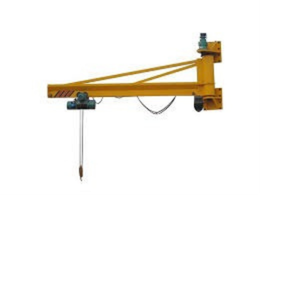
Floor Mounted Jib Crane Wall Mounted Jib Crane


Gantry Crane Semi-Gantry Crane


Floor-Operated Crane Bridge Crane


Electric Powered Hoist Manual Hoist (Lever, chain fall, come along)


Pneumatic Powered Hoist Chain Sling


Metal Mesh Sling Wire Rope Sling


Synthetic Web Sling Fiber Rope Sling
4.0 Design & Safety Requirements
4.1 The design of all cranes and hoists constructed after 1971 must comply with the requirements of the American Society of Mechanical Engineers and American National Standards Institute’s (ASME/ANSI) B30.2.0-1967 standards for crane construction; and the Crane Manufacturer’s Association of America standards CMAA-70-2010 and CMAA-74-2010.
4.2 The rated load of the crane must be plainly marked on each side of the crane. If the crane has more than one hoisting unit, each hoist shall have its rated load marked on it or its load block, which must be clearly visible from the floor.
4.3 Safety features shall not be disabled.
4.4 Only designated/authorized personnel who have been properly trained may operate or use cranes, hoists, or slings.
4.5 Cranes must be operated according to the manufacturer’s instructions
4.6 Clearance from obstructions:
4.6.1 A minimum clearance of three (3) inches overhead and two (2) inches laterally must be provided and maintained between the crane and any obstruction.
4.6.2 Where passageways, foot-walks, or walkways exist, their placement must not present a hazard to employees when cranes are in use.
4.6.2.1 Foot walks shall be of rigid construction and designed to sustain a distributed load of at least 50 pounds per square foot and shall be slip resistant.
4.6.2.2 Elevated walkways must provide adequate fall protection such as appropriate guardrail systems.
4.7 Cranes with parallel runways must always maintain a clear path of travel for the crane.
4.8 Trolley stops and/or bumpers should be provided to limit the travel of the trolley along the runway and be capable of sufficiently stopping the trolley.
4.9 Guards shall be securely fixed in place for all moving parts where there is potential for hazardous contact. Crane electronic controllers should be equipped to shut the crane to the “off” position when the control is released.
4.10 Hooks used as part of crane operation must be equipped with a safety latch to prevent loads from bouncing off the hook.
5.0 Crane Operation Requirements
5.1 Pre-operational inspection/test – At the start of each work shift (on a day when the crane will be used), operators shall complete the following steps to ensure the crane is operating properly. Pre-operational inspections/tests shall be documented.
5.1.1 Test the upper limit switch – raise the unloaded hook block until the limit switch trips.
5.1.2 Visually inspect the hook, load lines, trolley, and bridge as much as possible from the operator station (typically this is at floor level)
5.1.3 If provided, test the lower limit switch.
5.1.4 Test all direction and speed controls for both bridge and trolley travel
5.1.5 If equipped, test bridge and trolley limit switches when crane use will come close the tripping these switches.
5.1.6 Test the hoist brake.
5.1.7 If any above items do not pass the pre-operational inspection, the crane must be locked out and removed from service immediately.
5.1.8 Appendix A provides an example of a pre-operational checklist. Checklists should be specific to the crane being inspected. Consult the manufacturer’s specifications to develop or obtain a monthly checklist.
5.2 Rigging a load – when attaching a load to a crane, the following safety requirements shall be followed
5.2.1 Determine the accurate weight of the load and ensure crane and hoist weight limitations are not exceeded.
5.2.2 Determine the appropriate size and number of slings and associated components.
5.2.3 Sling capacity is reduced when the load connection is not directly under the hook. Riggers must calculate the sling capacity due to the sling-to-load angle. Never rig a load with a sling-to-load angle of less than 45 degrees.
5.2.4 Sharp edges on loads being lifted/lowered should be padded to prevent wear on slings.
5.2.5 Ensure slings and hooks are in proper working condition with no excessive wear. Never use equipment, such as ropes, tie-down straps, chains, bolts, eyebolts, shackles, or spreaders not designed for lifting. Always use equipment according to the manufacturer’s requirements.
5.2.6 The hook capacity, or safe working load (SWL) must be equal to or greater than the sling capacity, regardless of the weight of the load.
5.2.7 Use a shackle with two or more slings instead of attaching the slings to the hook. This allows the load to be centralized on the hook for full capacity.
5.2.8 Determine the load’s center of gravity and ensure the rigging maintains the load at level orientation during movement.
5.2.9 Once slings are in place, lift the load only slightly off the ground to test the rigging and balance. Re-work the rigging if necessary.
5.2.10 Use a tagline when loads must traverse long distances or be otherwise controlled.
5.3 Lifting and lowering a load – during equipment moving operations, with or without a load, the following safety requirements shall be followed.
5.3.1 Only authorized personnel may operate a crane.
5.3.2 Ensure proper clearance in all areas of crane use and prevent unauthorized entry. 5.3.3 Cranes should only be operated with an authorized operator with at least one spotter.
5.3.4 If audio (voice/radio) communication between the crane operator and spotter is not possible, use hand signals. Signals must be discernible or audible at all times by both the crane operator and spotter.
Standard Hand Signals

5.3.5 Ease the load up/down to prevent shock load on the crane. Shock load can occur when a suspended load is accelerated or decelerated quickly in any direction.
5.3.6 Lift loads only high enough to clear the tallest obstruction in the travel path.
5.3.7 Never leave suspended loads unattended. If a load must remain suspended in an emergency, ensure the area is clearly marked with signage and blocked on all four sides to prevent unauthorized access.
5.4 Parking a crane/hoist – once loads are moved and the crane is out of operation for the shift, it should be properly parked.
5.4.1 Remove all slings and accessories from the hook and return rigging devices to designated storage locations.
5.4.2 Raise the hook at least 7 feet above the floor.
5.4.3 Store the pendant away from aisles and work areas, or raise it at least 7 feet above the floor.
5.4.4 Place the emergency stop switch in the off position.
5.4.5 Place the controller in a designated storage location to prevent unauthorized use.
6.0 Inspection, Maintenance, and Testing
6.1 Cranes must be continuously inspected to ensure accidents do not occur. The pre-operational inspection must be conducted before each use as outlined in section 5.0 of this program.
6.2 Monthly inspections:
6.2.1 Cranes shall be inspected monthly. Cranes that are idle for more than one month shall be inspected before the next use. The inspection shall include all ropes on the crane. The inspection shall be documented.
6.2.2 Monthly inspections shall be conducted by someone familiar with the crane and its operations. Monthly inspections shall be documented.
6.2.3 Defective cranes must be removed from service and locked out of service until defects are corrected.
6.2.4 Appendix B provides an example monthly crane inspection checklist. Checklists should be specific to the crane being inspected. Consult the manufacturer’s specifications to develop or obtain a monthly checklist.
6.3 Annual preventative maintenance
6.3.1 Cranes shall be inspected annually for preventative maintenance.
6.3.2 Cranes, which sit idle for periods longer than 6 months or are unused, shall be inspected prior to anticipated use.
6.3.3 A properly trained crane specialist designated by the supervisor, or third-party company should perform and document the annual PM service.
6.3.4 A sample annual checklist can be found in Appendix C. Checklists should be specific to the crane being inspected. Consult the manufacturer’s specifications to develop or obtain an annual inspection checklist.
6.3.5 The annual inspection should address, at a minimum, the following items.
6.3.5.1 Hoisting and lowering mechanisms
6.3.5.2 Trolley and bridge travel
6.3.5.3 Limit switches and safety devices
6.3.5.4 Structural members
6.3.5.5 Bolts or rivets
6.3.5.6 Sheaves and drums
6.3.5.7 Moving parts such as bearings, shafts, gears, rollers locking and clamping devices
6.3.5.8 Fuel, electric or other power plants
6.3.5.9 Chain-drive sprockets
6.3.5.10 Crane and hoist hooks
6.3.5.11 Electrical controllers, limit switches, and push button stations
6.3.5.12 Slings (wire, metal mesh, fiber mesh, rope, etc.)
6.3.6 Specific inspection items may vary depending on the type of crane being inspected. The supervisor’s responsibility is to ensure the manufacturer’s specified inspection checkpoints are covered during the annual PM service.
6.4 Load testing on newly installed or recently repaired cranes
6.4.1 Newly installed cranes and hoists, and those which have undergone sufficient repairs or have been re-rated, shall be load tested at 125% of the rated load, prior to use.
6.4.2 Slings should be accompanied by load test data upon purchase. Load test data shall be maintained by the crane owner/operator.
6.4.3 Any time a crane is overloaded during use, it shall be inspected before returning to use. A properly trained crane specialist designated by the supervisor, or third-party company should perform and document the inspection.
7.0 Standard Operating Procedures
7.1 The crane owner or department shall document and maintain a Standard Operating Procedure for each crane. The SOP shall, at a minimum, include:
7.1.1 Identity (manufacturer, make, model, serial number) of the crane
7.1.2 Person responsible for managing and maintenance of the crane
7.1.3 Name(s) of all personnel authorized to use the crane
7.1.4 Name(s) of all personnel authorized to rig loads
7.1.5 Contact information for the crane service provider
7.1.6 Pre-operational test and inspection procedure(s)
7.1.7 Procedures for rigging a load
7.1.8 Crane operating procedure, including rigging instructions, lifting, lowering, and moving a load, and parking and storing the crane
7.1.9 Procedure for taking a crane out of service, including isolation, lockout tagout, and how to report deficiencies and initiate repairs.
7.1.10 Records and recordkeeping requirements including maintenance and inspection and repair records
7.2 A sample SOP template is provided in appendix D – “Sample Standard Operation Procedures”
8.0 Training
8.1 Only designated trained persons shall be permitted to operate a crane.
8.2 Training should include, at a minimum, the following:
8.2.1 Classroom/online informational training, which should include the following:
8.2.1.1 General Crane Safety
8.2.1.2 Crane inspections
8.2.1.3 Attaching, raising, lowering, and moving loads
8.2.1.4 Hand signals
8.2.2 Hands-on training with the specific equipment to be used as part of their job duties, to include the following:
8.2.2.1 Specific controls for the crane
8.2.2.2 Specific slings used with loads
8.2.2.3 Specific handling instructions as provided by the manufacture
8.2.2.4 Specific hand signals developed for use with the individuals using the crane
8.2.3 Written examination: both the classroom and hands-on training should be documented through an examination process. Training shall be valid for three (3) years.
9.0 Recordkeeping
9.1 Each department is responsible for maintaining records relating to cranes in use.
9.2 Records to be maintained include the following:
9.2.1 A copy of specifications and operator manuals for all cranes and hoists, including manufacturer bulletins, recall notices, and updates. Maintain as long as crane is in service.
9.2.2 Training records to include the name of trainer and employee, date of training, and type of training. Maintain as long as crane is in service.
9.2.3 Pre-use, monthly, and annual inspection reports. The department shall review inspection records at least annually and initiate corrective actions for identified deficiencies
9.2.3.1 Maintain pre-use and monthly inspector records until the next annual review
9.2.3.2 Maintain annual inspection records as long as the crane is in service.
9.2.4 Maintenance and repair records. Maintain as long as crane is in service.
10.0 Non-Standard Crane-like Lifting Devices
10.1 Non-standard devices and equipment used for lifting people or equipment should be used and maintained as designed and engineered; and as required by the manufacturer.
10.2 Chain-fall or lever operated hoist attached to a structure must be inspected by an engineer to ensure the capacity of the hoist and load does not exceed the attachment point.
10.3 Contact NC State EHS for assistance or evaluation of suitability and safety of personnel.
11.0 Contractors
11.1 Contractors are required to have their own specific crane, hoist, and sling safety programs and allow only fully trained crane operators.
11.2 Contractors using non-NCSU cranes must ensure cranes are properly maintained and have been recently inspected to ensure safe operation.
11.3 Contractors are permitted to use NCSU – owned cranes with authorization from the department responsible for the crane. All applicable standards, regulations, and NCSU Written Programs must be followed.
12.0 References
12.1 Occupational Safety & Health Adminsitration 29 CFR 1910 Subpart N Materials Handling and Storage.
12.2 Occupational Safety & Health Adminsitration 29 CFR 1910.184 – Slings
12.3 Occupational Safety & Health Regulations for Construction 29 CFR 1926.251 – Rigging Equipment for Material Handling
12.4 Occupational Safety & Health Regulations for Construction 29 CFR 1926.1438 – Overhead & Gantry Cranes
12.5 American Society of Mechanical Engineers and American National Standards Institute’s (ASME/ANSI) B30.2.0-1967 – Standard for Overhead and Gantry Cranes
12.6 American Society of Mechanical Engineers and American National Standards Institute’s (ASME/ANSI) B30.9 – Slings
12.7 American Society of Mechanical Engineers and American National Standards Institute’s (ASME/ANSI) B30.11 – Monorails and Underhung Cranes
12.8 American Society of Mechanical Engineers and American National Standards Institute’s (ASME/ANSI) B30.16 – Overhead, Underhung and Stationary Hoist
12.9 Crane Manufacturer’s Association of America standards CMAA-70-2010 and CMAA-74-2010
Appendix A – Sample pre-operational crane inspection form

Appendix B – Sample monthly crane inspection checklist

Appendix C – Sample annual crane safety inspection checklist

Appendix D – Sample Standard Operation Procedures
Purpose
To provide requirements for the operation and management of all cranes and hoists in the [Department].
Scope
This document applies XXX crane() located at [Building], [Room]
Model #: xxx-xxx-xxx
Serial #: yyy-yyy-yyy
Date of Manufacture: MM/DD/YY
First date in Service: MM/DD/YY
Definitions/Acronyms
In the context of this document, the following definitions apply:
- Crane: Any certified powered equipment designed specifically for lifting loads exceeding 500kg above head height and which is a fixed item.
- Crane Operator: A certified person who has control of the operation of the crane including all slinging and lifting functions.
- Rigger: A certified person empowered to apply slinging techniques including the selection and inspection of lifting equipment.
- Lifting Equipment: Any device which is used to connect a load to a crane and which does not form part of the load, e.g. wire rope, slings, and hooks.
- SWL: Safe Working Load as shown on the crane, slings, and other lifting equipment.
- Routine Lift: Work that is covered by a standard operating procedure (SOP) or checklist and does not require a Permit to Work. Routine work nominally involves medium to high-frequency tasks.
- Non-Routine Lift: Any activity that is outside the regular operations of the crane in that location. Non-routine work is not normally covered by an SOP or checklist. It generally involves low to medium-frequency tasks with medium to high levels of risk and the work may require a Permit to Work depending on the risks identified in an initial risk assessment for the work.
- Competent Person: A person who has, through a combination of training, education, experience, knowledge, and skills enabling that person to correctly perform a specified task.
- Leaders/Supervisors: Any university member responsible for supervising staff and/or undergraduate or postgraduate students and/or leading research projects.
- Workers: Employees, students on work experience, contractors, sub-contractors, and their employees. Staff, students on work experience, and contractors may be referred to collectively as workers, or separately as staff, students, or contractors
Procedures
Crane Operation
- Name of primary person responsible for managing use and maintenance of crane(s) described
- Contact Information
- Name(s) of personnel authorized to conduct frequent testing
- Name(s) of personnel authorized to conduct annual testing.
- Name and contact information for crane service provider
- Name(s) of personnel authorized to operate the crane(s) described
- Name(s) of personnel authorized to rig loads carried by the crane(s)
- Pre-operational test
- Department Procedure
- Post-operational test
- Department Procedure
- Corrective Actions
- Department Procedures (Which deficiencies require the crane to be locked out and taken out of service? Which deficiencies require action but not service lockout.
- Department Lockout Tagout Procedure
- Rigging a load
- Department Procedure
- Lifting and lowering a load
- Department Procedure
- Parking a crane/hoist
- Department Procedure
Crane Operators
- Ensure the SOPs for the work are followed;
- Conduct pre and post-lift inspection of the crane and lifting equipment;
- Ensure there are appropriate access restrictions in place to prevent entry to the area by any persons not involved in the lift;
- Report any maintenance needs that are identified to the [Name]
Riggers
- Location of and access to rigging equipment
- Determine the accurate weight of the load and ensure crane weight limitations are not exceeded.
- Determine the appropriate size and number of slings and associated components. ● Sharp edges on loads being lifted/lowered should be padded to prevent wear on slings.
- Inspect slings and hooks prior to each use. Ensure slings and hooks are in proper working condition with no excessive wear.
- Determine the load’s center of gravity and ensure rigging maintains the load level during movement.
- Once slings are in place, lift the load only slightly off the ground to test the rigging and balance, and re-work the rigging if necessary.
- Use a tagline when loads must traverse long distances or be otherwise controlled.
- Determine the accurate weight of the load and ensure crane weight limitations are not exceeded.
- Determine the appropriate size and number of slings and associated components. ● Properly store and secure rigging equipment in [designated location]
Recordkeeping
Maintain the following records:
- Specifications, operator manuals, and service bulletins, for all cranes and hoists
- Training records to include the name of trainer and employee, date of training, and type of training.
- Pre-use, monthly, and annual inspection reports, maintain pre-use inspection records for at least one year.
- Maintenance and repair records
Appendices
Instructions: Use appendices sparingly. If forms or other items are included as appendices, consider identifying them as EXAMPLES if it is acceptable to edit them when they are used. If no appendices are included, delete this section